
What Is the Best Diet for Type 2 Diabetes remission?
The answer depends on your goals but it gets much easier to understand when you break a diabetes diet into four components:
How many calories should you eat?
How much protein do you need?
How many carbohydrates can you currently tolerate?
How much fat does that leave?
Then you measure what happens and adjust.
Start With the ADA Diabetes Plate
There is a very clear and simple formula recommended by the American Diabetes Association called the Diabetes Plate Method.
You start with a nine-inch plate.
Fill:
Half with non-starchy vegetables
One-quarter with lean protein
One-quarter with quality carbohydrate foods such as whole grains, beans, starchy vegetables, fruit, or dairy
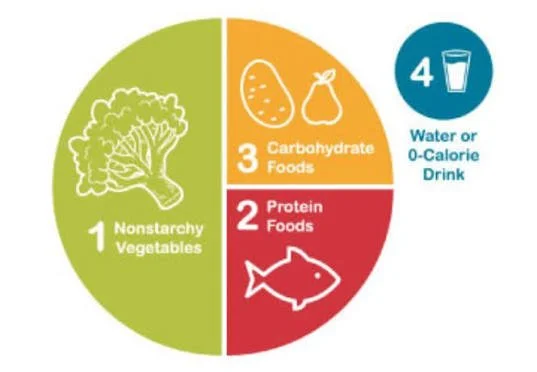
That's actually a useful starting point.
If you were recently diagnosed with type 2 diabetes and told me, “Dr. Adam, I don't want to count calories or macros. Just show me what my plate should look like,” this is a reasonable place to start.
But there's a harder question: What If Your Goal Is Type 2 Diabetes Remission?
If you're trying to pursue type 2 diabetes remission rather than simply improve your diet, I think you need to get more specific.
I can't tell every person with diabetes to eat exactly 1,800 calories, 150 grams of protein, and a quarter plate of carbohydrates at every meal.
Your body size is different.
Your muscle mass is different.
Your activity level is different.
Your A1c might be 6.6%. Someone else's might be 11%.
You might need to lose 60 pounds. Someone else might not need to lose any weight.
You may have been diagnosed six months ago while someone else has had diabetes for 15 years.
The list goes on and on.
So there isn't one perfect type 2 diabetes remission diet.
There is, however, a starting prescription that can be adjusted until it's specific to you.
And that's where these four components come in.
1. Determine How Much You Should Eat
The first question is simply: How much food should you eat?
In other words, how many calories?
At the most basic level, we're choosing between three possibilities.
A calorie deficit means you're eating less energy than your body needs.
Maintenance means you're eating roughly enough to maintain your current weight.
A calorie surplus means you're deliberately eating more than your body needs.
If you have type 2 diabetes and excess body fat—especially excess abdominal and visceral fat—we're probably going to start with some degree of calorie deficit.
If you're already lean and we're trying to add muscle, that's a completely different situation. And yes, you can absolutely be lean and still have metabolic disease and type 2 diabetes.
Very broadly, I might see someone eating anywhere from around 1,500 to 3,000 calories per day, sometimes less or considerably more.
That's a massive range, I know.
And that's the point. The appropriate calorie intake depends on your body and your goals.
2. Determine Your Protein Target
Next is protein.
Again, the amount depends on your goal. Get used to hearing that when we talk about food.
You need enough protein to preserve muscle, and ideally build some muscle.
You also want enough protein to help you feel full.
And if you're trying to lose weight, getting enough protein becomes particularly important because we want as much of that weight loss as possible coming from fat rather than muscle.
A very broad target might be somewhere around 100 to 200 grams of protein per day.
That might sound like a lot, but when I do a diet analysis, I typically see people eating closer to 80 to 100 grams per day.
So for many people, we're starting with fewer calories and more protein.
Maybe we determine that you need 140 grams of protein per day, or maybe it's closer to 160 grams, which is around what I personally aim for.
The point is that we're no longer blindly saying, “Eat more protein.”
As you can see, we're starting to build your specific diet prescription.
3. Determine Your Current Carbohydrate Tolerance
This is where diabetes nutrition gets really interesting—and confusing.
In my experience, this is also where a lot of people get stuck so I encourage you to think about carbohydrate intake as a spectrum.
At one extreme, you have essentially zero-carbohydrate carnivore diets.
Then you have ketogenic diets, typically around 20–50 grams of carbohydrate per day.
Then you have very-low-carbohydrate diets around 50–100 grams per day.
The ADA Diabetes Plate doesn't prescribe a specific number of carbohydrate grams per day. Depending on the foods and portions someone chooses, however, you could easily end up around 100–150 grams per day.
And a typical American diet can easily contain 200–300 grams of carbohydrate per day.
But here's the challenge with carbs: Less isn't automatically better.
Zero grams of carbohydrate isn't necessarily better than 50 grams for every person with high blood sugar.
The question I want you to answer is:
How much carbohydrate can I currently tolerate while still accomplishing my goals?
That's what we're trying to figure out.
I start with a carbohydrate intake based on things like:
The severity of your diabetes and current A1c
Your medications
Your activity level
Your body composition
Your weight-loss goals
What you're realistically willing to do
Then we test the carb mount to see if it’s too much or too little.
What's happening to your fasting glucose?
What happens to your blood sugar after meals?
What does your continuous glucose monitor (CGM) graph show?
Is your A1c coming down?
Are your weight and waist circumference changing?
How's your hunger?
How's your energy?
All of these things can be affected by what and how much you're eating, which is why it's important to actually measure the response.
Most of the people I work with initially start somewhere below 100 grams of carbohydrates per day, depending on the severity of their diabetes and what they can realistically stick with for the next few months.
For example, I recently worked with someone who started with an A1c of 9%.
That's firmly in the diabetic range, but he had also been diagnosed relatively recently.
We landed on a strict lower-carbohydrate approach for several months, which was significantly less carbohydrate than a quarter of his plate.
Four months later, his A1c was 5.9%.
He did more than simply cut carbohydrates, but he also didn't have to go full carnivore to get those results.
And here's another important point:
His starting diet doesn't necessarily need to be his forever diet.
Once you stabilize your blood sugar, lose excess body fat, become more active, and hopefully build some muscle, your carbohydrate tolerance may improve.
Then we test again, and adjust.
4. Determine How Much Fat You Need
Finally, we have dietary fat.
I generally think about fat as what's left after we've established your calorie, protein, and carbohydrate targets.
Protein and carbohydrates each contain about four calories per gram.
Fat contains about nine calories per gram.
So once I know your total calorie target, protein target, and carbohydrate target, we can figure out approximately how much room is left for fat.
That might be 50 grams, 100 grams, or even 150 grams.
This is especially important if you're following a keto, carnivore, or very-low-carb diet.
Low-carb doesn't automatically mean fat loss if you're eating too much fat.
If you need to lose significant body fat, I don't want low-carb to accidentally turn into unlimited cheese, butter, nuts, cream, bacon, and added oils.
You can absolutely eat a very-low-carbohydrate diet that's also extremely high in calories.
Carbohydrate restriction can be a very useful tool for controlling blood sugar, but if fat loss is part of the goal, total energy intake still matters.
So, What Is the Best Diet for Type 2 Diabetes remission?
Here's the frustrating answer:
It depends on your goals.
But hopefully you now understand why it depends.
The ADA Diabetes Plate gives you a simple, general framework for building healthier meals and managing blood sugar.
For some people, that might work extremely well.
But if your goal is specifically to pursue type 2 diabetes remission, I think you need to get more precise.
You need to know approximately:
How much food should you eat?
How much protein do you need?
How many carbohydrates can you currently tolerate?
And how much fat does that leave?
And remember:
That's still only the starting point.
Your first diet is a hypothesis—a best estimate.
We prescribe it.
We collect data.
And then we see what happens.
Sometimes I make adjustments within a week because someone's blood sugar, hunger, energy, or weight tells me we're off.
Other times, the plan is working beautifully, so we leave it alone and reassess after 30, 60, and 90 days.
Eventually, particularly with carbohydrates, I want to know whether you can tolerate more than you could when we started.
The point isn't to deprive yourself of a burger and fries forever.
The point is to improve your metabolic health and learn what your body can actually handle.
A Simple Framework for Building Your Diabetes Diet
That's why there isn't a single perfect diabetes diet I can put on this page, and tell everyone to follow.
Your goals are different. Your starting point is different. And your response is different.
But I can give you the framework:
Set your calories → Set your protein → Find your carbohydrate tolerance → Fill your remaining energy needs with fat → Measure → Adjust
Yes, it's a process.
But this is how you turn generic diabetes nutrition advice into a diet that's actually built for you.
And when you get it right, it can be remarkably effective for stabilizing blood sugar while supporting fat loss, energy, muscle, and your
Want help pursuing diabetes remission?
I’m a naturopathic physician accepting new patients in Montana and offering type 2 diabetes consultations and coaching outside of Montana.
If you’re trying to lower your blood sugar, reduce medication, or find out whether remission is realistic for you, book a consultation and we’ll figure out the right next step for your goals.
Prefer to call?
406-546-2164